
Covrigi (Romanian bread rings)
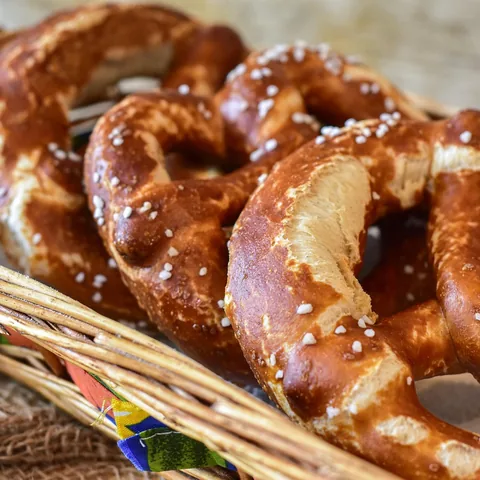
Covrigi are small ring-shaped breads with a shiny crust and a dense, chewy crumb. They are brushed with egg and scattered with coarse salt, sesame or poppy seeds before baking. Sold fresh at bakery kiosks and railway stations, they are eaten warm on the go or with cheese.
Diets
Allergens
Contains (in a typical recipe):
What it is made of
Recipe
Ingredients
- 500 g bread flour
- 7 g dry yeast
- 280 ml warm water
- 20 g oil
- 10 g salt (in dough)
- 1 egg yolk for brushing
- 20 g sesame, poppy seeds and coarse salt
Method
- Mix flour, yeast, water, oil and salt and knead 10 minutes to a smooth dough.
- Let it rise for 1 hour until doubled.
- Divide into 8 pieces, roll each into a rope of 40 cm and join the ends into a ring.
- Rest the rings 20 minutes, then brush with yolk and sprinkle with seeds or salt.
- Bake at 210°C for 18 to 20 minutes until deep golden.
How to make it lighter
- Use half wholemeal flour for more fibre.
- Skip most of the coarse salt if you watch sodium.
- Pair with cottage cheese or a boiled egg for a balanced snack.
History
Ring breads of this kind spread through Central and Eastern Europe over centuries, and covrigi are the Romanian member of the family. They are linked to the pretzel and to the Turkish simit but are shaped as a smooth ring. On some religious holidays they are given out as alms.
Count it in one photo
Point your camera at the table — Me Nutrition recognises Covrigi (Romanian bread rings) and every other dish, with calories and macros for each. Ate only half? Slide it.
Download on the App StoreSimilar dishes

Values are estimates per 100 g for a typical recipe; home and restaurant versions vary. Diets and allergens are worked out from the ingredients of a typical recipe — always check with whoever cooked the dish. Not medical advice. Nutrition data: Me Nutrition dish database v15. How we count →